

Kabir as the Music of Today

How do you define Kabir? Poet? Mystic? Philosopher? Iconoclast? Progressive thinker? Impatient leader? Out-of-the-box trailblazer? Or was he none of these? Was he unto a category of his own – where lived experience was tempered with faith in human goodness, where ostensible simplicity belied a richly layered inclusive core?
More than five hundred years later, Kabir remains an enigma and a cult figure, an enduring symbol of an India that is inclusive, incisive, wise and forward-thinking. His work has inspired literary icons and musical geniuses, those who have defined and influenced a fluid modern zeitgeist.
In 1915, the English translation of Songs of Kabir was published by MacMillan. This was an anthology of poems by Kabir, to whom, even Rabindranath Tagore, the venerable translator of these 100 poems, looked up as a spiritual master. Evelyn Underhill, British writer, mystic and pacifist, who worked with Tagore on the book, ascribes the poems to the Hindi text of Kshitimohan Sen, scholar, Sanskrit professor, and an associate of Tagore, who gathered together a large collection of Kabir’s songs from both written and oral sources.
1915 was an era of tumult and war - the First World War had just begun - and Tagore had at his disposal also an unpublished former translation of 116 songs by Santiniketan teacher Ajit Kumar Chakravarty. Kabir’s words opened a floodgate for Tagore – they were a treasure trove that embodied a universal love for God, transcending boundaries -- songs that claimed that divine presence is inherent in every being. That our relationship with God is direct, personal and free of intervention and prejudice. These were revolutionary views which catalysed as much change in the 15th century as they did in ensuing eras.
Consider this from the same anthology - ‘He is neither manifest nor hidden, he is neither revealed nor unrevealed: There are no words to tell that which He is.’ These words remain uncannily resonant when the modern world is scrambling to comprehend the idea of divinity. It is no wonder to me that Kabir’s ethos is increasingly becoming the makings of a modern anthem and a healing salve for a collective consciousness precariously poised between binaries.
Vivid imagery and straightforward language, focusing with startling simplicity on love and unity, heighten the profound effect of Kabir’s verse – they speak without frill but get to the point without detours – you realise with a sharp jolt what was always staring at you as universal truth – and you wonder what all the fuss is still about.
No surprises then that Kabir's verses would play the mellifluous muse for today’s musicians, who strive to find unity among many discordant notes. Contemporary music has strung Kabir’s ideas in multiple forms, including indie artists and Bollywood musicians who have set his earthy dohas to music that coerces, cajoles, guides and speaks with a pithy candour. Kabir’s expansive and syncretic spiritual philosophy, which seeks inner peace, and propounds at every step the idea of an omnipresent divinity, is deeply inspirational for modern-day artists and musicians who have seen no other way but to compose and ‘perform’ Kabir’s wisdom for a new generation.
Bollywood trailblazers continue to seek meaning for the masses and amplify musical impact in and with Kabir: the quintessential mystic. Kumar Gandharva, Jubin Nautiyal, A.R. Rahman and so many others have all woven Kabir's message in the rich fabric of eclectic rhythms and notes.
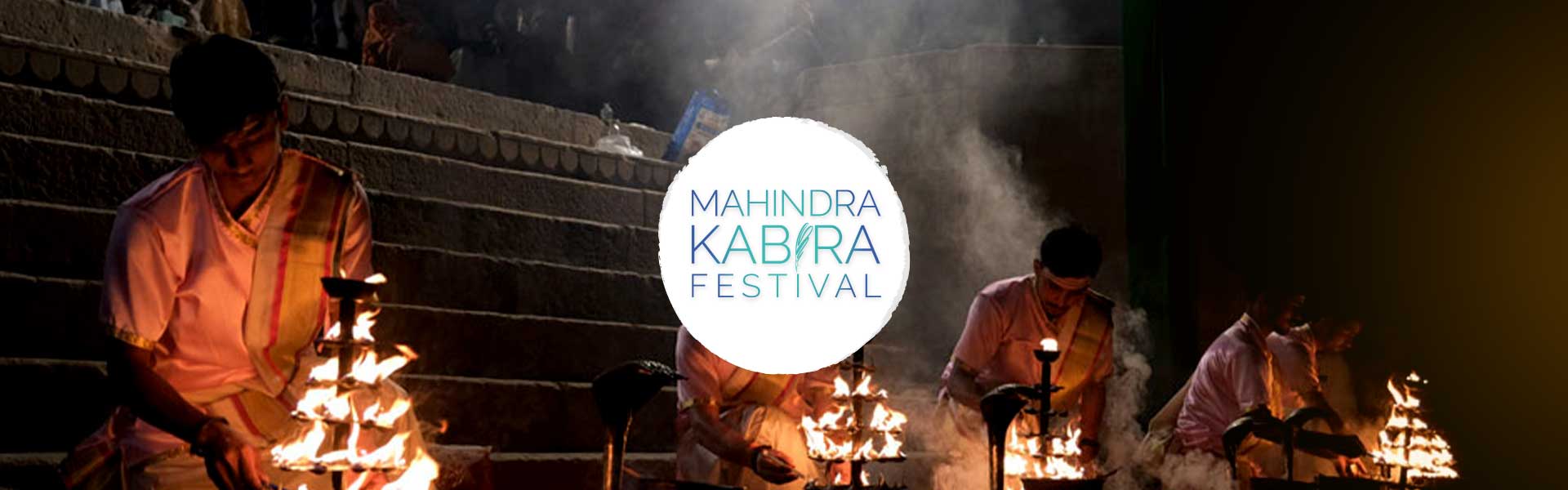
Music groups like Neeraj Arya's Kabir Café who play "Kabir Rock”, Shubha Mudgal who often sings Kabir’s songs, rich in both metaphor and ideology; The Kabir Project (Shabnam Virmani and Vipul Rikhi) whose initiative documents and spreads Kabir's message through music and film; Sonam Kalra and the Sufi Gospel Project; singers like Prahlad Singh Tipaniya, Mooralala Marwada, and even pioneering rock bands like Indian Ocean ingeniously blend musical styles with Kabir’s eternal lyrics to create startling new-age medleys. What stands out to me though is that they have all performed at the annual Mahindra Kabira Festival – a multi-faceted and immersive tribute to Kabir.
At Mahindra Kabira Festival each year, including in the forthcoming edition to be held from 19th- 21st December, we explore the entire gamut of Kabir’s wisdom, interpreted in words and woven in music that is stitched in the contemporary damask of current churn – from Kabir the Julaha: Verses from the Loom Dholak Rani by Shivangini, featuring Isha Priya Singh to the Aditya Prakash Ensemble, who blend the traditions of South Indian Carnatic with the improvisational spirit of jazz, and the raw energy of folk, rock, and classical styles. An ensemble that actually grew out of collaborations among students in the UCLA’s Ethnomusicology programme, influenced by tours with the legendary Ravi Shankar, the group embodies the music of today, infused by the wisdom of Kabir.
This year’s music programme at Mahindra Kabira Festival (https://mahindrakabira.com/) will lay out a tapestry of tune and verse, and walk the grand arc of one of the world’s most inclusive philosopher-poets. Have you booked your winter sojourn to the baffling, bewildering, and yet timeless city of Varanasi?

Arundhati Nath
Write your comment here